
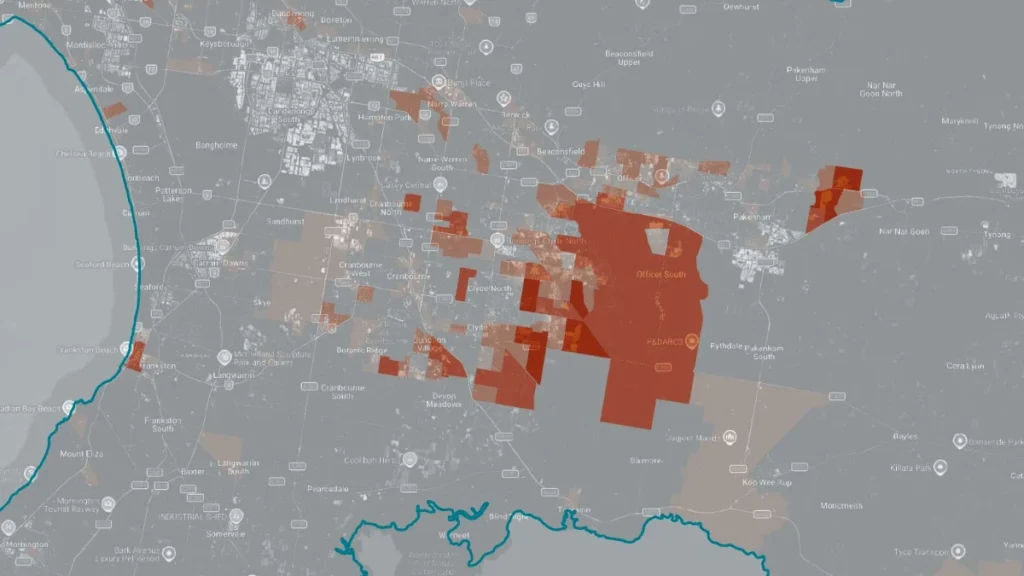
Demographic Solutions recently partnered with Spatial Economics to provide information for a Melbourne utilities authority. While many companies will look to the next five or ten years in terms of their outlook strategy, many government functions have a much longer timeframe. This is a huge challenge for population forecasters, given that there is an enormous leap of faith required to provide meaningful information.
Melbourne housing land supply: where greenfield tightens first
Based on current rates of development, most greenfield areas around Melbourne are likely to see readily developable land fully depleted within the next 15 years. This applies to most areas in Casey and Cardinia, Wyndham and Whittlesea. It is likely that Melton and Hume will still have some zoned Greenfield land in 2041, but it will be in extremely high demand and ever-diminishing.
Constraints in established suburbs & activity centres
Strata fragmentation, NRZ/Heritage, land‑use competition near major hubs
Development continues to proceed across Melbourne in established areas, but there are some key limitations to ongoing growth in these areas. Areas in the inner city and around major suburban hubs are increasingly constrained by existing strata titles and fragmentation. Areas in the CBD and surrounds will continue to and increasingly have considerable land use competition with other purposes such as office space, commercial land and education-related purposes, with universities having an insatiable appetite for more space. The prevalence of Neighbourhood Residential Zones and Heritage Overlays add to the constraints in many inner and middle suburban areas.
While there are significant opportunities in middle and outer suburban areas for greater densities and higher rates of residential development, many of those inner-city issues are becoming more widespread, most notably in and around major transit and commercial hubs. In particular, many of these centres have large numbers of strata title units and low-rise flats which constrain opportunities for high density development in the next few decades.
Case study: Boronia Activity Centre—redevelopment hurdles
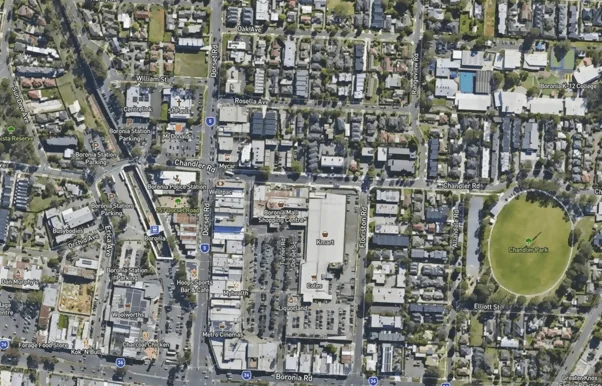
The Boronia Activity Centre highlights some of the challenges. Large areas of prime residential land within walking distance of the station have townhouses, units and low-rise apartments meaning that the ‘best’ places for higher density are already developed. The redevelopment of those areas to high density will require significant land banking or policy changes that force owners to consolidate. This is a typical middle to outer suburban scenario, affecting a broad range of centres, especially in the eastern and south eastern suburbs.
Boronia Commercial Centre (North East area)
Source: MetroMaps
Housing tools to 2051: HCTZ density shifts & LDRZ conversions
Under‑utilised LDRZ pockets ready for standard zoning
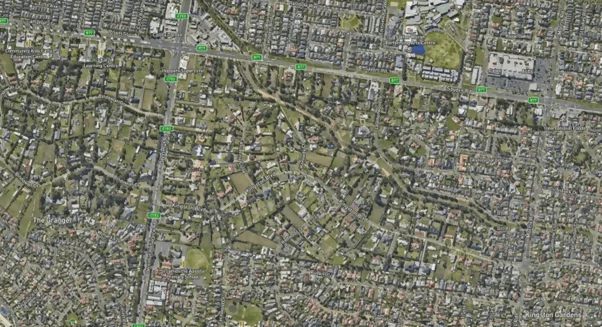
There are also some interesting opportunities within Melbourne by rezoning areas that are currently ‘underutilised.’ There are a number of Low-Density Residential Zone (LDRZ) areas in outer and fringe growth councils that could be converted to more standard residential zones. The most obvious areas that could be rezoned are the areas where standard density development has enveloped LDRZ areas that were previously meant to be an interface with rural and farming areas on the edge of Melbourne. These areas will and probably should be re-zoned, given their access to services and facilities.
Kingston Boulevard area, Hoppers Crossing
Source: MetroMaps
Examples: Hoppers Crossing, Greenvale, Templestowe, Narre Warren
Instances where pressures on LDRZ land include Hoppers Crossing, Greenvale, Templestowe, Narre Warren South, Pakenham, parts of Narre Warren North and some areas on the Mornington Peninsula. There have been a large number of recent rezonings to former LDRZ areas in outer and fringe LGAs including Hillside (to NRZ1), the Collison Estate in Cranbourne East (GRZ1), Pound Road, Hampton Park (GRZ1) and Woodbyne Crescent, Mornington (underway).
Realities of Urban 'Overspill' & regional employment
Bass Coast, Baw Baw, Mitchell, Macedon Ranges, Moorabool
It is possible that other land may be ‘discovered’ or unlocked in the Metropolitan area that are currently outside the Urban Growth Boundary, but this will require considerable legislative wrangling, if not abandonment of the urban growth boundary tenet. The truth is that most of the fringe growth councils will struggle to identify significant additional land even if environmental and planning principles are loosened.
There is very little land left in Casey full stop. Cardinia is heavily constrained in the south by the flood prone nature of the land and by the environmental values and topography of the north, although some Princes Hwy corridor expansion could be considered. Wyndham has little land left if you assume that the metropolitan waste treatment plant and the adjacent horticultural area in Werribee South will remain and that no development will occur beyond the proposed outer orbital road. Melton has significant constraints in the north due to flightpath issues from Melbourne Airport. This also affects areas in Hume although previously some areas have been mooted for residential development, west of Greenvale and Craigieburn. Whittlesea LGA seems to be a more plausible option, with potential to extend the plenty corridor north to Whittlesea township. Any other land that might be rezoned to urban purposes would still need to be assessed to see if it should be used for other purposes. One of the current key issues for the PSP process in all fringe metropolitan local government areas is the need to reserve land for employment. Many of the employment functions in outer areas are land-hungry, with a high share of warehousing.
Partner with us
Demographic Solutions is keen to further enhance its understanding of development potential. We already have existing database of residential land and sites, but there are opportunities to further refine this information based on expert input. We are seeking to partner with local government and other authorities to identify additional areas for residential development, and further develop a typology approach to rank sites and test those criteria against market preferences.